Friday, December 08, 2006

"We gave the Japanese cause to remember Pearl Harbor too."


(L) A turret of 8-inchers hurls 300 lb. of steel and explosive at Jap's island base.

(R) Heavy cruiser spits smoke and flame as nine 8-in. guns go off in mighty Salvo.

Life February 23, 1942
Thursday, December 07, 2006

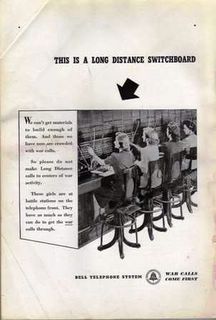
War Calls Come First

Bell Telephone System writes: "We can't get materials to build enough of them. And those we have now are crowded with war calls.

So please do not make Long Distance calls to centers of war activity.

These girls are at battle stations on the telephone front. They have as much as they can do to get the war calls through.


The National Geographic Magazine. November, 1942
Made You Look.

Virgie Bell's View

I was to write my childhood growing up in the shadow of World War 11, and I will try to do that, but being an American child, my perspective would be much different than that of children from other parts of the world. My perspective is different as an adult also.

I was neither in the World Trade Center nor in the other two places attacked: the Pentagon and that lonely field where with dying breaths fellow citizens foiled the attempted target to wherever the enemy had in mind. We do know that those passengers had cell phones and did know of the success of the other two planes. We do know they gave up their lives rather than let another target be hit. We also know that the American people woke up to the fact that we are despised by forces they cannot hope to understand...Assuming that my parents were not idiots. I understand the steel used for the bombs that dropped on Pearl Harbor was furnished by us. We did not mean to furnish the steel for any purpose other than peace. In fact, Japan, at the time of the bombing, had an envoy signing a peace treaty. War had been declared on America on our soil then, just as it was on Sept.11. The difference being that the guilty had a homeland, a place to aim our military, crippled as it was. We were not then a superpower. But we were a people. The American People.

We have always been in wars because we fight principalities and the source of evil itself...our only hope with this enemy is that they would love their children more than they hate us, even though we know for a fact that they will hold them within a mothers arms and blow herself and her child up just to kill a few of us. Just as it always has been just as it always will be, as long as we exist...period.

Like everyone else with half a brain I watched as Colin Powell pointed out chemical and biological facilities in Iraq. They did exist just as they did when we saw the same thing in Cuba. No matter what else I believe about this war, the very most I can hope for is that George Bush is not an evil man, and that the God he prays to is truly the one in whom I believe. I have to believe that the God I pray to is God. I have no other hope than that, a faith in something not seen, a hope in hope, or I am left with nothing. My God is not a practical joker. That is blasphemy and neither is God mocked, nor is He divided. Everything that God said is true. Or it is not. Not being a brilliant person, sometimes I have to look at the simplest things in the simplest terms.


Lisa, my daughter came by today in tears, afraid that she in her ignorance had prayed for her country, that she was somehow responsible...and in her ignorance she helped to kill Aaron with her prayers. So I will say this if her working every day to care for her family, her aging parents, every stray animal that comes along, if that is then evil, we are evil. The only thing we have to fear is fear itself, and we live in hope, and believe. It’s all we ever had in the past, all we have in the future. We will either win this war or any war by the grace of God.

Yes, I was a child during World War 11. I remember scrap metal drives, rations for gas, bomb drills at my school and search lights in the sky. But most of all, I remember the soldiers who fought so that I have the freedom to express myself. The Marines who bravely fought and all of those who died for our country and on this day, Pearl Harbor Day, I want to thank you from the depth of my heart for the sacrifice and for all of those spending this day away from home so that I can be safe in my home, God bless each and everyone of you.

SUPPORT OUR TROOPS

Our House

December 7, 2006
Thursday 2:42 PM CST

Gary, my brother, has just called to tell me that he and Karen will be here in about an hour and a half. I felt pretty sure they would be back this afternoon, so I have my stuff loaded in the car, ready to go home and see my own four-legged children and the man I love whose been feeding and appeasing them for a couple of days while I’ve sat with Gary and Karen’s four-legged babies, Sadie and Bonray.

I cried a little bit when it got time to leave just now. Not because I don't want to go home, but because I’ve put it off since I got here on Tuesday. The cry, I mean. The past two days have been my first time alone in this house in a long while, and I used to stay here alone (with the babies, of course) often.

Before I leave this home, one first opened up to me in 2001, I had to sit down and write. This very moment, I’m perched in the same chair I used to sit in, hunched over a-just-my-size-kitchen-bar, where I once wore out erasers on fifteen various No. 2 pencils I perpetually lined up, first sharpened on the pencil sharpener my brother had screwed into a wall of his garage for me; before hitting the hour long two lane highway waiting on me, I had to sit once again, sans pointy pencils, three page equations, and ten Spanish verbs, finally, conjugated, memorized and shortly, forgotten.

When I enrolled in Texas Tech University in the fall of 2001, Gary and Karen offered me a place to stay during the week while I attended classes. Their home in Brownfield is less than forty miles from Lubbock, while mine is about one ten.


There's a lot of history here in this house I once visited more than my own. It became our house. I was part of Sadie and Bonray's family. I'm Auntie to them like I am to Kayla.

When the Twin Towers burst into a death sentence for countless lives and untold future decisions, I was in an early morning Algebra class. After the class was over, I overheard a young guy who was sprawled out in the buffed tile hallway, waiting his turn for math punishment, I heard him say to the girl next to him, "They," he said, lifting his brow and cocking his head toward the file of wanna be mathematicians, "don’t know yet.”

I didn’t give his statement much thought (though now, I'll never forget his words), and walked marathon miles to the parking lot, got into my truck, a truck that once belonged to Aaron, and behind the steering wheel, books to my right side, I kept my head down, hunched over some book for the next hour while much of America riveted. It wasn’t until my 12:30 British Lit class that I learned of the morning's surreal events. The attacks of terror.

When I got home to Brownfield that evening, Karen was in the den. She’d been home ill from work and had remained parked before the jet and mortar images on a Sanyo screen all day. We looked at each other for a full minute, then quietly sat together in disbelief, in horror really, watched and listened, numbed. Later, we forecasted and conjured. We grew into generals with clear plans, then went to bed and woke up with the same disbelief in the reality of it all.

From the vantage point of Gary and Karen’s house, I watched as our nation united. I listened to a determined Commander In Chief. I studied God’s Word in a novel way. I fought with tests from school, tests from home. I waited for Recruit Austin’s letters from San Diego, and then from here, I flew to witness my son graduate from USMC Boot Camp on 18 Jan 2002. I bid my son farewell as he left for war, and here I fell apart on the Day from Hell. Day five of the war, the day when our first soldiers were captured and paraded on TV.

Since that time, I’ve been with Aaron here in my brother’s back yard, swimming, dancing, laughing. Gary and Karen loved it when Aaron was home on leave. Together, Aaron and I would always spend a day or two here with them. Christmases too, with Aaron and the rest of the family, here at our home away from home.

It was here Aaron told me, “Mom, I’ve got about five things I want to confess in my life. I’m going to tell you three tonight.”


No. Don’t ask.

I’ve worried and prayed a lot from this spot I’m about to depart.

The wind chimes here sing in a deeper tone than mine. Still, beautiful in a lonely sort of way.

It saddens me to see the gray in Sadie’s and Bonray’s muzzle. But it’s been good being here. Alone for the first time in this house since I lost Aaron.

Different concerns now, prayers rearranged somewhat.

Perhaps it’s the day. Pearl Harbor. Their 9/11.

I don’t know why Aaron had to leave. I’m just glad he was here.

Black Heroes of Pearl Harbor


The battle at Pearl Harbor had its own heroes. One of them was Doris (Dorrie) Miller, the USS West Virginia’s heavyweight boxing champion. Dorrie carried his wounded captain to safety, then manned a sub-machine gun and shot down three enemy planes.

What makes his courage even more extraordinary is that Dorrie had never handled a machine gun before.

He was black, and like all African-Americans in the Navy at the time, he was assigned to menial tasks. In his case, as a mess attendant. Fourteen men received America’s highest military award for heroism on that day, but not Dorrie. He received the Navy Cross instead. He was the first black to receive that medal, but he was passed over for the highest honor.

Dr. Stephen Ambrose, historian and National Geographic Explorer-in-Residence, says in "Legacy of Attack:" "The beginning of the breakdown of racial segregation in the United States started here in Pearl Harbor. Black men, just like everybody else, saw a buddy down there in that oil-covered water with fire going on … and he dove in to save him. That happened again and again. White America began to learn that there’s an awful lot of bravery, skill, endurance and character in black America."

Dorrie Miller was killed two years after Pearl Harbor, when his ship was torpedoed by a Japanese submarine.

I'll Be Seeing You

My love affair with the era we call the Greatest Generation began in high school. I picked up "The Longest Day," the classic telling of D-Day by Cornelius Ryan, and read about the courage and determination of American warriors who began the war with one leg kicked out from under them at Pearl Harbor.

I was hooked, and I began reading book after book about World War II. I bought Big Band music, listening to Glenn Miller's "Moonlight Serenade." When I listened to the music from that era, I could feel the will of America pounding with the beat of "In The Mood," and I could sense the longing for loved ones in the words of "I'll Be Seeing You."

Americans were relieved to be done with the Great Depression. Prosperity energized a country that was emerging from a national financial disaster, and men and women were eager and proud to do whatever was necessary to defend their country after the attack on Pearl Harbor on Dec. 7, 1941. That fervor, that pride in country, was new to a boy who grew up in the divisive years of the Vietnam War.

While I read book after book about World War II, my awe increased. The country was united, determined to destroy Germany, Japan and Italy. Civilians rationed and did without so that resources could be diverted to the military. I have some of the ration books my grandparents used during the war to buy butter, shoes, sugar, gasoline and other commodities. None of that spirit seemed to exist during Vietnam. If it did, I missed it.

Instead, I saw the My Lai Massacre, as historians call it, screaming from the magazines and newspapers. The campus riots, especially Kent State, were foreign demonstrations to a boy growing up in the conservative Texas Panhandle. The evening news rarely failed to report on Johnson's withering administration, and the chants from the protestors outside the White House gates still echo in my mind.

That was the war I grew up with, and the Watergate scandal, arriving on the heels of our pullout from Vietnam made me more weary of an era plagued with assassinations, riots and an unpopular conflict. I escaped into my books about World War II, where the vision of a country flush with prosperity and love of country soothed me. I admit that I romanticized the military, and I did join the Air Force a few years later. It wasn't the escapade-loving military I had read about in the books on World War II. Instead, it was an organization that was largely populated by cynical and usually bitter veterans of Vietnam. Some of them made my life hell. But overall, I liked the Air Force.

I know the United States wasn't perfect during the years of World War II. We were segregated, and no black Americans received a Medal of Honor during the war, although I'm certain, some of them displayed the heroism deserving of one. We weren't a perfect nation, but we were a patriotic one.

It's that feeling I long for and wish we could capture again on this anniversay of Pearl Harbor.

The USS Arizona Memorial

Today the battle-scarred, submerged remains of the battleship USS Arizona rest on the silt of Pearl Harbor, just as they settled on December 7, 1941. The ship was one of many casualties from the deadly attack by the Japanese on a quiet Sunday that President Franklin Roosevelt called "a date which will live in infamy."

The Arizona's burning bridge and listing mast and superstructure were photographed in the aftermath of the Japanese attack, and news of her sinking was emblazoned on the front page of newspapers across the land. The photograph symbolized the destruction of the United States Pacific Fleet at Pearl Harbor and the start of a war that was to take many thousands of American lives. Indelibly impressed into the national memory, the image could be recalled by most Americans when they heard the battle cry, "Remember Pearl Harbor."

More than a million people visit the USS Arizona Memorial each year. They file quietly through the building and toss flower wreaths and leis into the water. They watch the iridescent slick of oil that still leaks, a drop at a time, from ruptured bunkers after more than 50 years at the bottom of the sea, and they read the names of the dead carved in marble on the Memorial's walls.

The Declaration Of War


Mr. Vice President, Mr. Speaker, members of the Senate and the House of Representatives:

Yesterday, December 7, 1941 - a date which will live in infamy - the United States of America was suddenly and deliberately attacked by naval and air forces of the Empire of Japan.

The United States was at peace with that nation, and, at the solicitation of Japan, was still in conversation with its government and its Emperor looking toward the maintenance of peace in the Pacific.

Indeed, one hour after Japanese air squadrons had commenced bombing in the American island of Oahu, the Japanese Ambassador to the United States and his colleague delivered to our Secretary of State a formal reply to a recent American message. And, while this reply stated that it seemed useless to continue the existing diplomatic negotiations, it contained no threat or hint of war or of armed attack.

It will be recorded that the distance of Hawaii from Japan makes it obvious that the attack was deliberately planned many days or even weeks ago. During the intervening time the Japanese Government has deliberately sought to deceive the United States by false statements and expressions of hope for continued peace.

The attack yesterday on the Hawaiian Islands has caused severe damage to American naval and military forces. I regret to tell you that very many American lives have been lost. In addition, American ships have been reported torpedoed on the high seas between San Francisco and Honolulu.

Yesterday the Japanese Government also launched an attack against Malaya.Last night Japanese forces attacked Hong Kong.Last night Japanese forces attacked Guam.Last night Japanese forces attacked the Philippine Islands.Last night the Japanese attacked Wake Island.And this morning the Japanese attacked Midway Island.

Japan has therefore undertaken a surprise offensive extending throughout the Pacific area. The facts of yesterday and today speak for themselves. The people of the United States have already formed their opinions and well understand the implications to the very life and safety of our nation.

As Commander-in-Chief of the Army and Navy I have directed that all measures be taken for our defense, that always will our whole nation remember the character of the onslaught against us.

No matter how long it may take us to overcome this premeditated invasion, the American people, in their righteous might, will win through to absolute victory.

I believe that I interpret the will of the Congress and of the people when I assert that we will not only defend ourselves to the uttermost but will make it very certain that this form of treachery shall never again endanger us.

Hostilities exist. There is no blinking at the fact that our people, our territory and our interests are in grave danger.

With confidence in our armed forces, with the unbounding determination of our people, we will gain the inevitable triumph. So help us God.

I ask that the Congress declare that since the unprovoked and dastardly attack by Japan on Sunday, December 7, 1941, a state of war has existed between the United States and the Japanese Empire.

Franklin D. Roosevelt - December 8, 1941

The West Virginia Sinks


The sunken battleship USS West Virginia in the foreground with the heavily damaged USS Tennessee seen behind.

The Japanese Attack

A Japanese photo taken during the aerial torpedo attack on Battleship Row at Pearl Harbor on the far side of Ford Island. A torpedo has just struck the USS West Virginia (center). Also seen are (from left) Nevada, Arizona, Tennessee, Oklahoma (torpedoed and listing) alongside Maryland and California.

At 7:53 a.m. on Sunday, Dec. 7, 1941, the first assault wave of Japanese fighter planes attacked the U.S. Naval base at Pearl Harbor, Hawaii, taking the Americans completely by surprise.

The first attack wave targeted airfields and battleships. The second wave targeted other ships and shipyard facilities. The air raid lasted until 9:45 a.m. Eight battleships were damaged, with five sunk. Three light cruisers, three destroyers and three smaller vessels were lost along with 188 aircraft. The Japanese lost 27 planes and five midget submarines which attempted to penetrate the inner harbor and launch torpedoes.

Three prime targets: the U.S. Pacific Fleet aircraft carriers, Lexington, Enterprise and Saratoga, were not in the harbor and thus escaped damage.

The casualty list at Pearl Harbor included 2,335 servicemen and 68 civilians killed, and 1,178 wounded. Over 1,000 crewmen aboard the USS Arizona battleship were killed after a 1,760-lb. aerial bomb penetrated the forward magazine causing catastrophic explosions.

The USS West Virginia


The USS West Virginia aflame after the Japanese attack on Pearl Harbor on Dec. 7, 1941.

The USS Arizona


The USS Arizona burns after the Japanese attack on Pearl Harbor on Dec. 7, 1941.

The USS Shaw explodes during the Japanese attack on Pearl Harbor on Dec. 7, 1941.

Remembering Pearl Harbor

Charles Coulson, USN


Charles Coulson was the baby brother of MaMa, my maternal grandmother, who was the eldest of four living children.

Uncle Charles enlisted in the Navy right out of high school, but not before he gave Jane (his future wife) her first kiss when she was fifteen. "It was just a peck, but on the lips," Aunt Jane told me over the phone today. And when I asked her if he talked about the war any, she answered, "No, he never said much at all. I'm sure he wanted to forget a lot of it."

Jane was living in Abilene, TX when Pearl Harbor was bombed. She remembers feeling "devastated" when she first heard. She had every reason to fear for her boyfriend's life, for Petty Officer Third Class Coulson was aboard the USS Detroit docked at Pearl Harbor on December 7, 1941.

As fate would have it, the USS Detroit escaped without casualty, save a few superficial wounds which are noted in the following report:


DEPARTMENT OF THE NAVY -- NAVAL HISTORICAL CENTER

805 KIDDER BREESE SE -- WASHINGTON NAVY YARD

WASHINGTON DC 20374-5060

USS Detroit, Report of Pearl Harbor Attack
CL8/P3-1
U.S.S. Detroit
11/Ge/

Serial 1471

December 10, 1941.

From:The Commanding Officer.
To:Commander-in-Chief, U.S. PACIFIC FLEET.

Subject:URDIS 102102 December 1941.


1. Set Condition Zed throughout ship.

2. Manned and fired all A.A. Guns, both 3" and .50 calibre machine guns. Round fired: 422 3"; 10,000 .50 calibre.
3. Two planes were brought down by joint fire of this vessel and Curtiss.
4. Two men received superficial wounds.
5. No damage to ship, Motor boat sunk by explosion alongside Nevada.
6.No case of distinguished conduct.
7. One aerial torpedo passed about ten yards astern of Detroit at Berth F-8. Believe this torpedo buried in mud or coral between Berths F-12 and F-13.
[signed]L.J. WILTSE.
Copies to:

Combatfor

Comdesbatfor

Comcrubatfor

Source:

Enclosure (E) to CINCPAC action report Serial 0479 of 15 February 1942, World War II action reports,the Modern Military Branch, National Archives and Records Administration, 8601 Adelphi Road, College Park, MD 20740.

09/03/2003

***A fortunate crew indeed. Or so it would seem. The ship departed and spent much of her time near Alaska. Petty Officer Third Class Coulson returned home for leave and married the girl who'd feared for his life on that December Day, 65 years ago.

Charles and Jane repeated their vows on July 31, 1942. The sailor was medically discharged with stomach problems right before his hitch was up.

About a week ago, I'd asked my dad if he thought it had affected Uncle Charles in any visible way. "I think so. He never said much, except once he told me that for three days no one could choke any food down ...arms and legs were everywhere."

For many years, Uncle Charles drove a truck OTR. Eventually, he and Jane divorced and he is now deceased.

Aunt Jane is 82 and resides in Lubbock, Texas.

Thank you for your service and sacrifice, dear Sailor. RIP

Pearl Harbor Action Reports 7 Dec 1941

Wednesday, December 06, 2006

To Aunty

Make sure God blesses her, Aaron.
Take one step at a time, Aunty.
Feel his spirit ignite your heart
into emotional outbursts.
Notice his freedom came after death.
He didn’t die. He lived again.
He’s seen our Creator; his Creator.
Feel bright billowy grass bury
your petite feet into ground comfort.
Rest there in a magical garden
where you are cooled
with kaleidoscope clouds, a refreshed
breeze brushes your brow,
your tired fingers too.
Drop to your knees, lean
back and lie in wait as a buttery
sun melts green eyes
into a relaxed pose. Heartbeat
of the earth pumps rest,
then life
into your free body, no,
it’s not your heart
to beat into the earth.
It is hers and the God
who formed you both. Hard
ground from which The Potter
cast you; or could it be His
knocking, tapping. Talking.

Dear child, I am here. Dry
your worldly wings fly
free of cringing worry.
Let the mountains say,
You are here now, stay
as long as you want. Your son
will see you when you live
again, but for now, landscape
with Nature. Escape. Nothing
can harm you.
Enter this world until
your spirit is free, for now
take control of your life. Rest
now until you live again in the arms
of your son. I love you.

P.S. Aunty, it is okay to enter your kind world
and if you think people think you are crazy,
forget the world and God
will lift you in flight through skies'
crisp air. And I am always here.


Steve In Iraq: The Interview Continues

This show has been cancelled until Monday night, Dec. 11th

Steve will wrap up his interview tonight about his trip to Iraq. He'll be continuing his talk with Dave and Jenn at 6:00 PM CST. I plan on calling in for just a bit, and if you’d like to, the number is 347-996-5948. (Long distance charges will apply, so use your cell if it fits your plan.)

If you missed his interview on December 4th, you can still hear it. Ninety minutes of such an eloquent voice, Steve! Tell me, how do you do it?

Tune in if you can at My Point Blog Radio. No charge for listening!

Specialist Eric Vizcaino, USA and NM Loses A Soldier


New Mexico has lost another service member.

Spec. Eric Vizcaino

Hometown: , New Mexico, U.S.
Age: 21 years old
Died: November 21, 2006 in Operation Iraqi Freedom.

Unit: Army, 2nd Battalion, 505th Parachute Infantry Regiment, 3rd Brigade Combat Team, 82nd Airborne Division, Fort Bragg, N.C
.
Incident: Died in a non-combat related incident in Balad.

Salute to Captain Kermit Evans


Captain returning to Cannon killed in Iraq
Source: AP


HOLLANDALE, Miss. -- Family members said an Air Force captain from Mississippi was among four U.S. military service members killed when their helicopter went down in Iraq.


Margaret Evans of Hollandale, Miss.i, said her son, Kermit Evans, died Sunday when the Sea Knight helicopter plunged into Lake Qadisiyah in Anbar province.


He was a native of Hollandale and a graduate of Mississippi State University.

Evans, 31, was serving his second tour in Iraq.

His mother said he enlisted in the Air Force in August 2001 and was promoted to captain in November 2005.

She also said he had received orders about three weeks ago that he was going back to Cannon Air Force Base near Clovis.


Tuesday, December 05, 2006

Salute To The Fallen And Their Survivors


Gunz Up salutes Those who've given their all for our freedoms. God keep their survivors forever. We will never forget your loved ones' service and sacrifice.

Survivors of Pearl Harbor

The Fallen of November 2006

The Fallen of December 2006

Click here for some beautiful music that does take a while to load, but is really beautiful. The taps duet with a 21-gun salute reminded me so much of May 3, 2004, the day we buried Aaron.

And now I'm listening to Amazing Grace on bagpipes. It's beautiful.


To Steve From Turkey!


This photo was taken by National Geographic in Turkey.

Christi Costello sent it to me in an email, and I've lost the text, but anyway, in this photo taken directly overhead, the white marks are the actual camels, the black, their shadows.

Killing Is All That Matters


Ernie Pyle was the most famos and loved columnist during World War II. His devotion to American fighting men endeared him to readers and the military. In this column, Plyle explains how servicemen going into battle will be changed by the experience.

WITH THE AMERICAN FORCES IN ALGIERS, Dec.1, 1942 - From now onward, stretching for months and months into the future, life is completely changed for thousands of American boys on this side of the earth. For at last they are in there fighting.

The jump from camp life into front-line living is just as great as the original jump from civilian life into the Army. Only those who served in the last war can conceive of the makeshift, deadly urgent, always-moving-onward complexion of front-line existence. And existence is exactly the word: it is nothing more.

The last of the comforts are gone. From now on you sleep in bedrolls under little tents. You wash whenever and wherever you can. You carry your food on your back when you are fighting.

You dig ditches for protection from bullets and from the chill north wind off the Mediterranean. There are no more hot-water taps. There are no post exchanges where you can buy cigarets. There are no movies.

When you speak to a civilian you have to wrestle with a foreign language. You carry just enough clothing to cover you, and no more. You don't lug any knickknacks at all.

When our troops made their first landings in North Africa they went four days without even blankets, just catching a few hours sleep on the ground.

Everybody either lost or chucked aside some of his equipment. Like most troops going into battle for the first time, they all carried too much at first. Gradually they shed it. The boys tossed out personal gear from their musette bags and filled them with ammunition. The countryside for twenty miles around Oran was strewn with overcoats, field jackets and mess kits as the soldiers moved on the city.

Arabs will be going around for a whole generation clad in odd pieces of American Army uniforms.

At the moment our troops are bivouacked for miles around each of three large centers of occupation - Casablanca, Oran and Algiers. They are consolidating, fitting in replacements, making repairs - spending a few days taking a deep breath before moving on to other theaters of action.

They are camped in every conceivable way. In the city of Oran some are billeted in office buildings, hotels and garages. Some are camping in parks and big vacant lots on the edge of town. Some are miles away, out in the country, living on treeless stretches of prairie. They are in tiny groups and in huge batches.

Some of the officers live in tents and sleep on the ground. Others have been lucky enough to commandeer a farmhouse or a barn, sometimes even a modern villa.

The tent camps look odd. The little low tents hold two men apiece and stretch as far as you can see.

There are Negro camps as well as white.

You see men washing mess kits and clothing in five-gallon gasoline cans, heated over an open fire made from sticks and pieces of packing cases. They strip naked and take sponge baths in the heat of the day. In the quick cold of night they cuddle up in their bedrolls.

You see Negroes playing baseball under the bright African sun during their spare hours of an afternoon.

The American soldier is quick in adapting himself to a new mode of living. Outfits which have been here only three days have dug vast networks of ditches three feet deep in the bare brown earth. They have rigged up a light here and there with a storage battery. They have gathered boards and made floors and sideboards for their tents to keep out the wind and sand. They have hung out their washing, and painted their names over the tent flaps. You even see a soldier sitting on his "front step" of an evening playing a violin.

They've been here only three days and they know they're unlikely to be here three days more, but they patch up some kind of home nevertheless.

Even in this short waiting period life is far from static. Motor convoys roar along the highways. Everything is on a basis of "not a minute to spare." There is a new spirit among the troops - a spirit of haste.

Planes pass constantly, eastbound. New detachments of troops wait for orders to move on. Old detachments tell you the stories of their first battle, and conjecture about the next one. People you've only recently met hand you slips of paper with their home addresses and say, "You know, in case something happens, would you mind writing..."

At last we are in it up to our necks, and everything is changed, even your outlook on life.

Swinging first and swinging to kill is all that matters now.

The town as a whole has been turned back to the French, but the Army keeps a hand raised and there will be no miscues.

My MeMa (maternal grandmother) and her first little brother, Lonnie Dean McCurry. My grandmother was about 4.
Made You Look.

2LT. Lonnie D. McCurry, 1941
Made You Look.

Lonnie D. "Primo" McCurry

Uncle Lonnie and his unit's battles will continue with more in-depth coverage in "Blood Is Thicker Than Water."

He was born as the second of four children to my MaMa and PaPa Curry (the names I called my great-grandparents on my mother’s side) on March 7, 1919 in Claypool, Oklahoma as Lonnie Dean McCurry (and the only one of the four not born in Texas). While in high school, Lonnie was nicknamed “Primo” after an Italian Heavyweight Boxing Champion, Primo Carnera. Lubbock High counted my uncle as a valuable athlete and boxer.

Primo (a name that has stuck with him throughout his life) enlisted as a PFC in the United States Marine Corps through the Reserve Officers Corps while in his senior year at Texas Tech in Lubbock, Texas. He was called to active duty after graduation in May 1941.

McCurry began his training in Quantico, Virginia and was commissioned as a 2nd Lieutenant in September 1941. His training was cut short due to the bombing of Pearl Harbor, and after two months training at “Arty” school, 2LT McCurry transferred to the West Coast to join 2nd Marine Division before it was split to form 3rd Marine Division.

The LT, who was now a part of 3rd Marine Division, was then sent to New Zealand for further training before his first combat action in Bougainville. The 2nd Marine Division had been sent to Guadalcanal.

2LT McCurry served as Battery Commander for a 105MM Howitzer battery with Mike Battery, 4th Battalion, 12th Marines, 3rd Marine Division in Bougainville, Guam, and Iwo Jima. He received the Purple Heart in Guam for his injuries sustained on 21 July 1944 after receiving mine fragments to his left arm. Other decorations include the Navy Unit Commendation with 1 star, the American Defense Service Medal, American Campaign Medal, Victory Medal WWII, National Defense Service Medal, Korea Service Medal with 2 stars, and the United Defense Service Medal.

McCurry retired as a Lieutenant Colonel on 30 June 1961. He was selected for Texas Tech’s Football Hall of Honor in 2000. His selection for this honor is noted:

Lonnie "Primo" McCurry (2000)
Hometown: Lubbock
Football - 1938-40
*Little All-American in 1940 as guard
*Helped 1938 team to 10-1 mark and Cotton Bowl appearance
*Captained Pete Cawthon's final team to 9-1-1 record
*Drafted by Brooklyn, but entered military service instead
*Awarded Purple Heart for service during invasion of Guam during World War II


I think I've mentioned before that Aaron and Uncle Lonnie met one time in their lives at Aaron's Homecoming Party given in celebration of my son's return from OIF 1, which was held in Lubbock, Texas on August 2, 2003.

It will always amaze me the tight bond that was experienced by all of us with three Marines from three different generations in our large family's midst, and I will never be able to keep myself from grinning when I think of Uncle Lonnie's words to Aaron as Aaron struggled for an answer to give the reporter from ABC News when she asked my son, the leader of a 240 M Machine gun team,"And what was your job while you were in Iraq?"

As Aaron looked around for magical politically correct words with which to answer the reporter, our very distinguished Uncle Lonnie offered out, "You killed people. Isn't that what you did?"

Even the reporter had to grin. And of course, the video was well edited before the ten o'clock news that night!


The Three Marines on August 2, 2003. From left to right is Lonnie D. McCurry, Aaron C. Austin, and Bennie L. Pickrell.
Made You Look.

Rosie The Riveter: The Women of WWII


When the United States entered World War II in December 1941, life changed for everyone. All the factories were literally begging for help. They desperately needed workers, and soon the meager reserve of men who had not gone to war was exhausted. The U.S. Department of Labor declared a shortage of workers. To satisfy the demands, women were actively recruited for the work force. This change in the norms of society met opposition, so the government created the Rosie the Riveter propaganda campaign.

In 1940, only 10 percent of women who worked were employed by factories, but by 1944, the figure was up to 30 percent. Although pay was not always equal (the average man working in a wartime plant was paid $54.65 per week, while women on average were paid $31.21 per week), and conditions were sometimes very poor, women quickly responded to Rosie the Riveter, who convinced them they had a patriotic duty to enter the workforce. Some claim that she forever opened up the work force for women, but others dispute that point, noting that many women were discharged after the war and the jobs given to returning servicemen.

After the war the "Rosies" and the generations that followed them knew that working in the factories was in fact a possibility for women, even though they did not re-enter the job market in such large proportions again until the 1970s, and by that time factory employment was in decline all over the country.

The image most iconically associated with Rosie is J. Howard Miller's famous poster for Westinghouse, titled "We Can Do It!" which was modeled on Michigan factory worker Geraldine Doyle in 1942.

Men Went to War; Women Went to Work


Chippers -- Women war workers at Marinship Corp. in 1942.

Strong American Women


Women proved their skills during World War II when they went to work in the industries that supplied the military with the weapons and machinery it needed to ensure victory. These women welders took a break from their work to pose for a picture in 1943 along with an unidentified man.

Rolling Up Their Sleeves


Secretaries, housewives and waitresses -- women from all over central Florida enrolled in vocational schools to learn war-related work during World War II. The women pictured here were in the Daytona Beach branch of the Volusia County Vocational School.

Christmas Watch


Isn't this beautiful?

Happy December 5, 2006.

Photo scanned from Life November 30, 1942


Life February 15, 1943
Made You Look.

The U. S. Goes On "War Time"

Crew of the Rock Island "Rocket" turn their watches ahead to War Time at 2 a.m. Feb 9 in a blizzard outside Menlo, Iowa.

PICTURE OF THE WEEK

At 1:58 a.m. on Feb. 9, Engineer E.V. Coleman of the Rocky Mountain Rocket, crack Denver-Chicago express of the Chicago, Rock Island & Pacific Railway, cut his power, threw on his air brakes and eased his train to a halt on a stretch of track one mile west of Menlo, Iowa. Accompanied by his fireman, L.E. Durbin, he stepped from his cab into a howling blizzard. A moment later they were joined by conductor Fred Lykke, Brakeman A.O. Smith and Road Foreman of Equipment F.H. Sprenger. Together, precisely at 2 a.m. the five trainmen turned their watches forward one hour in accordance with a bill signed by President Roosevelt Jan. 20, placing the nation on War Time until six months after peace. Then while the snowstorm raged about their heads, the Rocket's crew cross-checked timepieces carefully and returned to their posts. At Menlo, Conductor Lykke and Engineer Coleman reported by wire that their watches had been adjusted to the new time.

Throughout the network of the nation's railroads other train crews performed similar ceremonies. In cities and villages from coast to coast, in stations, stores, banks, business establishments and private homes, clocks ticked an hour ahead of the sun. And next morning Americans arose and dressed in the dark. By adopting war time U.S. industries are expected to conserve 700,000,000 kilowatt hours of power a year.

Life Magazine February 23, 1942

Ladies Night


Most popular pin-up girl at Paramount is Dorothy Lamour. Her appeal is not entirely in her looks. Frequent bond-selling tours and Camp appearances help.

Life February 15, 1943

Junior Mothers


Junior Miss Maternity


At Lane Bryant's, oldest and biggest store specializing in maternity clothes, expectant mothers from 19 to 23 crowd corner with dresses in Junior Miss sizes.

Life August 31, 1942

Youthful Styles and Concealing Images


"TRACTORETTES"

Life November 30, 1942

Pictures To The Editor

KEEPSAKE

Sirs:

I wonder how many theater-goers and Somerset Maugham fans will recognize these stockings? They are a pair of heavy checked silk hose that Jeanne Eagels wore when she played the immortal Sadie Thompson in Rain. The drive to collect worn-out silk stockings for use in making powder bags unearthed these from a collection of Eagels' memorabilia.

SGT. HAROLD S. CARTER
New York, N.Y.
GROWING UP

Sirs:

When Lynn Lee Busby comes from Louisiana to visit my son Jack, I always take a picture of them embracing each other across a little iron fence. Three years ago LIFE printed two of these (Oct. 30, 1939). Here is the latest version. The spruce tree has also grown quite a lot. Lynn Lee is now 7, and Jack is 6.

At first it used to be Lynn Lee who was the more ardent of the two. This year, Lynn Lee, who has become something of a glamour girl, seems rather blase, even though Jack is in the "Army" and wears a uniform. Perhaps she is worried about getting home to Louisiana before gasoline rationing sets in. I'm afraid this will be their last meeting until the war is won.

W. JACK RODDEN
Roswell, N.Mex.

Life August 31, 1942

Monday, December 04, 2006

Give Him Your Holiday Trip

Life February 23, 1942

Life February 23, 1942
Made You Look.

December 2006

Gunz Up wishes everyone a beautiful and safe December. The countdown begins today!
Freedom; is many different definitions. I have different freedoms, the U.S., riding fast thing, writing, dancing, reading, watching the sky on my roof, and so many more. This weekend I had one of those freedoms, I drove a four wheeler. As much as this may seem like drama, it is a big freedom. I just want to go faster and faster and faster. But I can't do that or I would flip. Sunday morning when I was at Corrie's her dad was gone and said that we could ride it if her mom was out there. She wasn't and we still rode it. Corrie's dad told me that I couldn't drive it. I only flipped it once. Just kidding, I never did but I was dangerous and fast. But let's be reasonable that was an old person talking. So forget his rules, I drove anyway. Yes, it was fun, even though I still didn't know how to change gears I did good. Later when Corrie was driving it she started getting testy and peeling out and turning corners faster than she was. It was so fun and if I don't get a four wheeler for Christmas I will get something like that when I am older. Who knows I might be a biker by the time I am twenty- five. Even though it was freezing and we couldn't feel our hands or faces we could've rode for hours but we had to go get ready for the Nutcracker. Which was okay but not great. Next time maybe they could do the whole story. Macielok school was the one who did it. They were good and a lot better than my dance school, which is why right now I going in my room to stretch until I almost break, and I am not kidding.

Weston's Christmas Story

'Twas the night before Christmas and Weston was tired. His Daddy was sleeping, his Mother was wired, and just as she thought things had come to a close, Weston looked out at the gleaming white snow ...And what did he see as he gazed at the sight ... the night before Christmas on a cold winter night? He saw a star gleaming far up in sky, called to his mommy asking her why? Why is that star much brighter than all? What holds it up? Why doesn't it fall? Did Jesus come down from that star up above...to teach boys and girls the meaning of love? Is that why there's Christmas and wonderful toys...for nice little girls and good little boys?

His mommy laughed softly and said to her son, I guess it is time to get this all done....He put it so sweetly the heart understands ... maybe true wisdom is wasted on man. Maybe it takes a sweet little son, to understand the true meaning of love, when the eye can behold what his heart can still see. And thanks be to God his land is still free. She sang to him softly as she put him to bed and she felt her heart lifted and this she then said. Yes Jesus came down from a star up above, to teach boys and girls the meaning of love. Look in your heart and you shall see the meaning of Christmas as you've shown to me. Then she said softly as she switched out the light, Merry Christmas to all and to all a good night.

Goodnight, Weston. Granny-great loves you.

IMPORTANT ANNOUNCEMENT

Steve will be interviewed tonight at 6:00 PM CST by Dave and Jenn on "My Point" radio. Click here for information on tuning in, either during the broadcast or to hear later if you weren't able to tune in for the program.

Feel free to call in with questions or comments at (347) 996-5948.

We appreciate Dave and Jenn making this opportunity for Steve to be interviewed about his experiences in Iraq.

And Steve, get over your shyness. It was an exciting and fruitful trip. God brought you back to us ... tell us the story and share the adventure!

(Steve doesn't like attention. It's "the reporter" in him, I guess! We know you didn't singlehandedly defeat 40 insurgents...but you made it out alive when they didn't mean for you to!)

Virgie Bell's View

First of all let me express my strong opinion regarding the lead story on every channel and in the newspapers which is, of course, the ever-entertaining Ms. Spears, who is now entertaining us with the view of her now famous crotch. Seems this is a new and even bolder display among the ever delightful threesome: Lindsey Lohan, Paris Hilton and our darling Britney. Please, girls, put on your panties, and stop flashing your overused and much abused whoo whoo. It makes one long for Roseanne and Tom Arnold. I read that white trash everywhere are insulted by this behavior.

Mel Gibson's new movie is lagging behind and getting bad reviews. It seems he may have to content himself with owning Malibu, which is his claim. Now having never watched "The View" I cannot understand what Danny Devito was trying to say. Even with that going on, I got a profile shot of Barbara Walters, and she looks bad. Well not bad, but she really should get off that show. This is a famous newswoman. I remember her setting down in a tent with Kadaffi at the height of his power. Now she is reduced to this -- the useless "No Longer Queen of Nice" holding Danny Devito on her lap show. It is time to retire, or else when all else fails to attract attention, you could flash.
Well I finally read the 10 answers from Al Gore in Time magazine. Most of his answers were in showspeak. Something about his paw print in front of Grumman's Chinese Theater in the tradition of Rin Tin Tin. This is as over my head as when Emilio Estevez and the day the music stops remark. WHAT MUSIC? It sounds poetic but makes no sense at all.

The Democratic party got kind of embarrassing to me when it went so Hollywood in the last Clinton era. I would have loved for there to have been less junk food and movie reviews going on, but then as you know, Idon'tt understand showspeak.

On to the hard news about Al Gore's solution to the great disaster of global warming, and the good news is Barbara Boxer will see to it now as the Democrats are in power. Well goody. The editorials were full of advice for the War On Terror which comes in second place to Britney.

There is another civil rights and racist violation brewing over the women of Islam taking over our planes and screaming prayers to Allah and women refusing to cover their breasts while nursing. I would have covered my breast anyway, but then I am old fashioned in that way. As far as the prayers to Allah by the ones who also shout death to America, I would have been off that plane so fast that it would have made your head swim. Please let us get serious, and I do mean please. We have our military on the ground all over this world putting their lives on the line, and this is thdribbleel that captures our attention. It really would be funny, if only it wasn't so very, very sad.

SUPPORT OUR TROOPS

Sunday, December 03, 2006

Jesus Is The Season

I love my Lord. He who knew no sin became sin so that I might stumble upon the greatest gift I've ever known.The joy is truly overwhelming. What the world has to offer is worthless. What God offered at Calvary is priceless. I thank Jesus daily, for apart from Christ, there is no good.

Merry Christmas.

The Trip To Iraq: Part One

This is the first of my posts about my trip to the Middle East. I was going there to find and write news articles about the good work Americans were doing there. The escalating violence in Iraq cut my trip short.

On Nov. 18, I returned from the Middle East, a few weeks ahead of my scheduled return on Dec. 14. My six-week stay in Kuwait, Turkey and Iraq revealed unexpected twists in an adventure that tested my mettle. I wouldn't have missed it for anything.

I had called the Iraqi embassy in D.C. to ask about obtaining a visa. Entering Kuwait wasn't a problem, but I knew that it could be difficult to get an Iraqi visa. The man I spoke with in D.C. told me that I could apply for the visa at their embassy in Kuwait, so I left the states thinking I would be in Kuwait no more than a couple of days while they processed my visa. The wait was lengthier, so instead of twiddling my thumbs in Kuwait, I tagged along with a group of people I had met who said they were aid workers on their way to Turkey.

Having never been to the Middle East, I thought I'd try to see as much of it as I could in the short time I'd be there. The opportunity to see Turkey wasn't something I wanted to pass. I took off with the Europeans, thinking about a trip that I thought would make me feel like Lisa Ling on the hunt for a thought-provoking story.

We arrived in Istanbul, and while some members of the group were loading the truck with supplies, I walked a few feet away from them. One of the women, who seemed to have some authority in the group, was talking to a man who, I think, was in charge of the building that housed the supplies. They were speaking Italian, and because I'm fluent in Spanish, I could follow a good deal of the conversation. If I understood them correctly, they weren't taking on supplies for aid work; they were loading provisions for the insurgents in Iraq. There was a chance that I didn't understand the conversation correctly, but it wasn't worth my life to stick around. Because they were loading the truck, I had my duffel bag with me. I quietly walked away from them, leaving my camera that was still in the truck. Although I stuck out in the crowd of people in that part of Istanbul because of the military duffel bag on my back and my distinctly American clothes, I was away from the group who had possible ties to the insurgents. I found my way to the American embassy.

The Iraqi consul in Kuwait told me he would e-mail me when he received my visa, so I thought I'd explore Turkey while I waited for the news. As a journalist, I'm not shy in pushing my way around, and I found transportation to a village near the Iraqi border. I was interested in the Kurds and their long-standing opposition to Saddam, so I thought it would help my research if I could interview them.

The village didn't have electricity or running water and was the home to about 100 Kurds. Although I grew up in a poor family, and I had visited even poorer relations in Mexico when I was a boy, I wasn't prepared for the emotional poverty. The Kurds are a brave people who fight relentlessly for their culture and identity. For about a week, I stayed with a family who would bring their goats into the house for the night. The animals were valuable, too valuable to be left outside where predators could prey on them.

One evening during my stay with the Kurdish family, they showed me an exquisite chest that was probably a couple of centuries old. Upscale antique dealers in the United States would have salivated over it, but the Kurds didn't regard it as a treasure. Instead, they valued an article inside. One of the daughters pulled out a Tshirt that bore the logo of an American football team. Through our limited communication skills, I discerned that a relative received the shirt from an American during the Gulf War in 1990. They valued the garment that was worth about five cents in the United States and put it back in the chest that was worth several thousand dollars in an American market.

In Part Two I'll write about my stay with the Kurds.

Remembering the 62.5 Million Dead of WWII

The number of people killed during World War II is staggering. A total of 62,537,400 people died during the conflict that left so much of the world in ruins. The civilain total is 32,326,700 and the military total is 24,456,700.

The Soviet Union, allied to the United States, England and France, suffered a total of 23,200,000 deaths. Of that number 11,500,000 are civilians. The United States lost 407,000 members of the military and 11,200 civilians.

As we near the anniversay of the attack on Pearl Harbor, let us remember the men and women of previous generations who sacrificed so that we would know freedom.

American Liberators


American troops of the 28th Infantry Division march down the Champs Elysees in Paris in the Victory Parade in August 1944. Hitler had orderd Paris to be destroyed as the Allies neared the city, but German officers refused to obey the order and, instead, fled the French capital.

D-Day


American soldiers land on the coast of France under heavy Nazi machine gun fire on D-Day, June 6, 1944.

Full Victory -- Nothing Else


Gen. Dwight D. Eisenhower gives the order of the day, "Full victory -- nothing else" to paratroopers in England just before they board their planes to participate in the first assault in the invasion of the continent of Europe.

The Pain of Defeat


A Frenchman weeps as German soldiers march into Paris on June 14, 1940, after the Allied armies had been driven back across France. The United States hadn't entered the war yet. Due to the success of the Normandy invasion, D-Day, the Allies liberated Paris on Aug. 25, 1944.

World War II Suicide Bombers

Suicide bombers are nothing new. Two Kamikazes hit the USS Bunker Hill in 30 seconds on May 11, 1945, off Kyushu, killing 372 Americans and wounding 264.

Brothers Helping Brothers


Crewmen lift Kenneth Bratton out of the turret of a TBF on the USS Saratoga after a raid on Rabaul in November 1943.

Presidential Air


Navy pilots in the forward elevator well play basketball aboard the USS Monterey. Jumper at left is future President Gerald R. Ford.

Protector


Pfc Angelo B. Reina of the 391st Inf. Regt. guards a lonely Oahu beach position in March 1945.

Human Fighting Machines


A 1942 Navy recruiting poster reflects the power attributed to America's warriors. The men who served and protected the country were regarded with respect. How do we get that back?

Roy and Berry Lee Hobbs United States Army

I've spent some time trying to piece together the facts of Roy Hobbs. I'm afraid it's going to take longer than the five days remaining, but I will continue to pursue it. This man certainly deserves to be recognized.

The information I have gathered so far is this: Roy Hobbs was in the United States Army Band. He was also on the Bataan Death March and was a POW in the Philippines for three years. He and other American POW's were on a Japanese ship that the U.S.bombed. The Hobbs family learned of Roy's death, I think, about a month later.

Of course, all prisoners and enemies were buried at sea. Bombs and oceans are great equalizers.

It saddens me to know that I've had many opportunities for this very personal story from Roy's brother, Berry Lee Hobbs, who passed in July 2005. I've sat in Berry Lee's back office, at his kitchen table, held the (yellow?) POW "report cards" of Roy Hobbs' in my hands, witnessed the pain of the brother, still etched in the sibling's face, fifty, then sixty years later.

Berry Lee served in the United States Army as well. A clerk, he never left the states. I've wondered since, did this bother Berry Lee? I bet it was a relief to their mother.

But I've had the chance for this story and put it off until it was too late. Oh, I'll still get the story, but not from my friend.

Rest In Peace, Roy and Berry Lee Hobbs. Thank you for your service. Your sacrifice. Your family. And Berry Lee, your friendship.

Click here for Bataan Memorial Death March info at White Sands Missile Range.

Moonlit Hands

This is the poem I wrote in the 5th grade that my Aunt Karen wanted to see.

All is quiet, while my parents are asleep.
I stand up and walk to my window.
I kneel on a light blue bench, gently press
my hands together.I softly speak the words
of prayer. Praying for faith, patience, kindness
and so much more. The prayer words fade
in the moonlight. One clear word comes at the end, Amen.
I feel the prayer get sent into Heaven.
As I look at the silver clouds, I see the grayish moon
hiding behind them. I really hoped the moon
would come back out. It suddenly drifted out like it heard
my thoughts. I stared a it, it stared at me. The moon
glowed on my hands, which were still in prayer position.

Staring at my moonlit hands, I thought
about how I have always wanted to hear God, or see angels.
I felt a heart warming feeling while my hands
were flooded in the moonlight. Like something
I've always wanted to happen would come. But I was getting tired
and slowly walked back to my bed, leaving the moonlight
behind me. I fell to sleep quickly. A delicate sound
woke me up. An angel with heaven white feathered wings
was playing a golden harp while floating
in the air with the harp in front of her. She turned
to me and gently smiled.

Now I have seen an angel,
and then she disappeared.
Why did all this happen so suddenly? Only one
answer to that question that I know of. It had
to be moonlit hands.